Saxena Lab
Studying the underlying neural computations involved in cooperation by connecting the behavior of real rats in a cooperative task with virtual agents behavior in a virtual environment using multi-agent reinforcement learning. Work included building a behavioral analysis pipeline in python using pose-estimation data to study cooperative behaviors and strategies, as well as building and running simulations in our constructed RL environment.
Preparing the cooperation replay…
Behavioral Analysis
The experimental task asks pairs of rats to coordinate their actions by a pressing a lever simultaneously to attain a food reward. Pavlovian conditioning links a sound cue to food and instrumental training teaches each rat to press a lever and collect a reward independently. Then the real experiment consists of two rats entering a shared arena with separate levers and food ports. In each trial, both receive a reward only when their presses occur within one second (this data was collected by the Jane Taylor Lab).
I built a Python pipeline that aligns SLEAP pose estimates of five body points per rat at 30 frames per second with lever presses, reward-port entries, trial outcomes, and session metadata. It measures success, press timing, movement synchrony, spatial position, learning, social gaze, and physical interaction. Gaze is estimated by projecting head direction toward the partner, while sustained proximity identifies physical interaction.
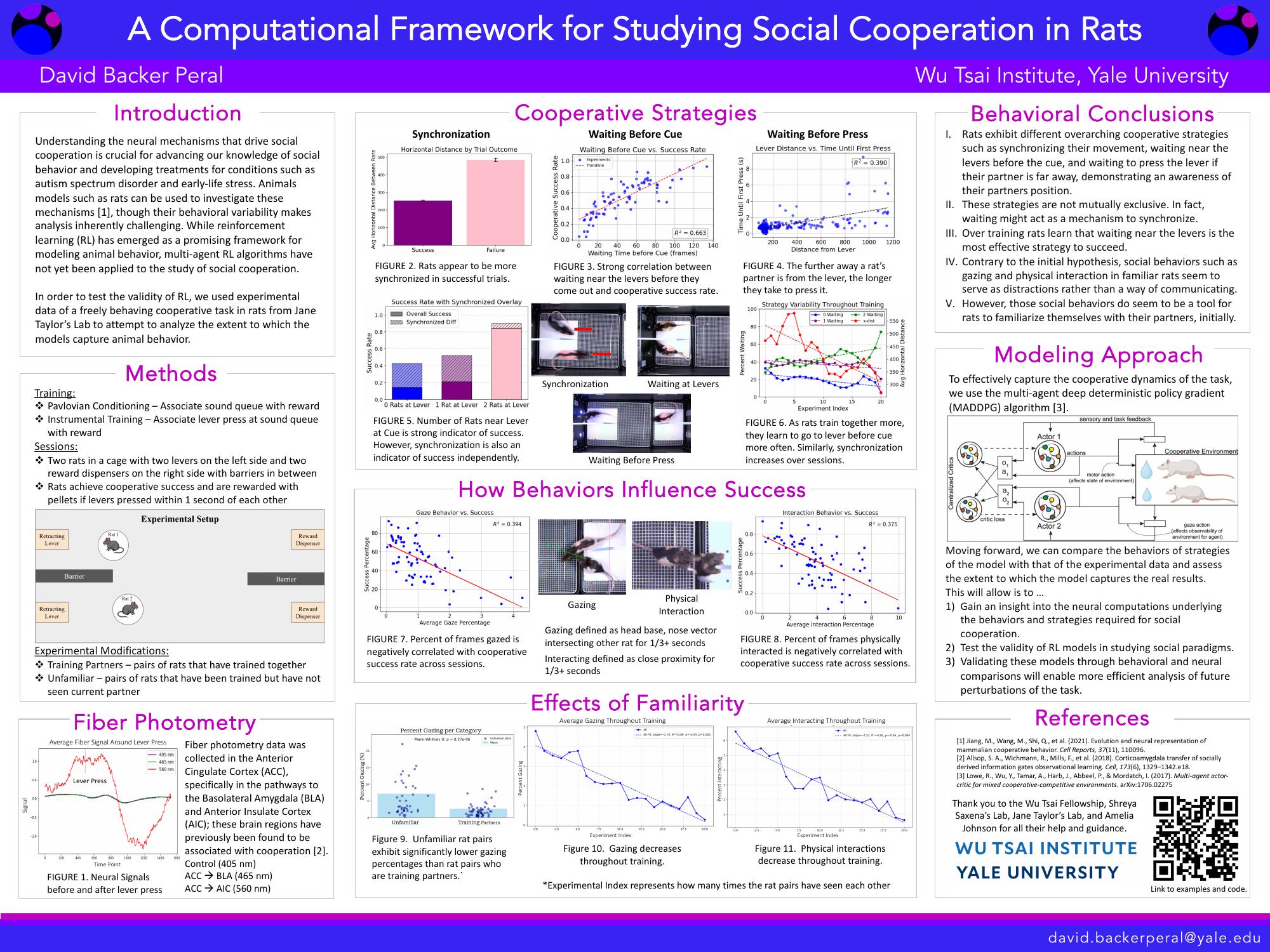
Some key results from this analysis include that rats exhibit different overarching cooperative strategies such as the synchronization of their horizontal movement and waiting near the levers before the cue, to be ready to press immediately. Rats also demonstrated an awareness of their partners position, by taking longer to press the lever when their partner was further away.
Furthermore, contrary to the initial hypothesis, both gaze and physical interaction were negative correlated with success throughout a session, but these behaviors decreased throughout training, providing a new hypothesis that these behaviors are a mechanism for the rats to familiarize themselves with each other and build the trust required to perform the task.
The analysis points to a coordinated strategy rather than simple simultaneous reactions. Successful trials contain more synchronized movement, and success is more likely when both rats are already near their levers when the cue begins. This waiting strategy becomes more common with training. Rats also delay pressing when a partner is farther from its lever, suggesting that timing depends on the partner’s position.
Reinforcement Learning Modeling
In collaboration with Amelia Johnson I also built a virtual version of the task for multi-agent reinforcement learning. Two agents move through bounded lanes, press separate levers, and collect rewards that appear only after sufficiently close presses. Their observations include task state, position, lever and reward locations, and, depending on the condition, information about the partner.
Three gaze conditions test how social information affects learning. Full gaze provides continuous partner position; partial gaze reveals the partner only when an agent chooses a gaze action; no gaze hides partner position entirely. Comparing them helps investigate the importance of an agent having information about their partner.
We also implement a recurrent predictive model that provides another route to coordination. It learns an internal representation of the other agent by predicting its actions from recent experience, then uses those predictions to supplement missing partner information or as an additional policy input. This tests whether anticipation can be a substitute for direct observation, and investigates the role of gazing in improving this predictive model.
To mirror the rats’ training history, I implemented independent instrumental pretraining, in which each agent first learns the lever-to-reward sequence alone before its policy initializes the cooperative task. Initial runs suggest that this curriculum can speed cooperative learning, although broader comparisons are still underway. A second curriculum begins with a wide press interval and tightens it when performance reaches a threshold. Together, these models test which observations, predictions, and learning histories are sufficient for cooperation to emerge.
Research Poster
Sharing the Work
I first presented A Computational Framework for Studying Social Cooperation in Rats at the Wu Tsai Undergraduate Research Fellowship summer symposium and in a lightning talk. The behavioral analysis work contributes to the coauthored bioRxiv preprint A Single Cooperative Experience Increases Corticolimbic Synaptic Density and Prosocial Behavior, which has been submitted for publication in journals.
I am continuing the project through an in-progress modeling and learning paper that builds on the preprint. It uses virtual agents to test how partner visibility, predictive representations, instrumental pretraining, and curriculum design affect cooperation, with the broader goal of connecting learned strategies to the behavior and neural activity observed in real animals.