NASA STEM Enhancement Intern
Compared deep-learning models for mosquito-larvae classification and helped build an optical experiment for testing in microgravity through the SEES program.
Computer vision for a public-health problem
In summer 2022, I worked on a research project comparing deep-learning architectures for mosquito-larvae classification. Using images from GLOBE Observer's Mosquito Habitat Mapper, our team prepared a dataset with more than 10,000 records from Africa, North America, and Latin America. Automating classification could help researchers make use of growing citizen-science datasets.
Comparing four architectures
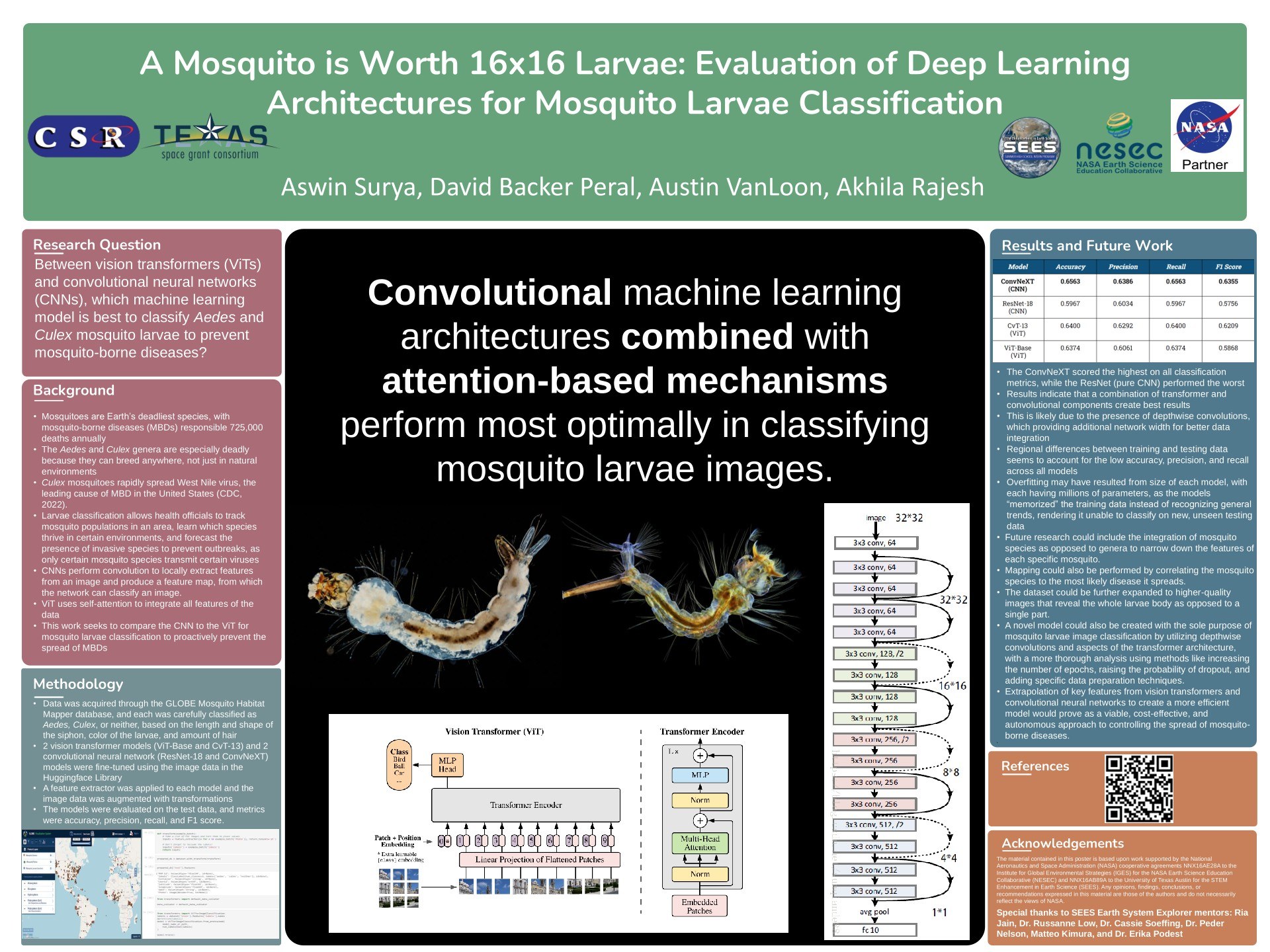
We evaluated ViT-Base, ConvNeXT, CvT-13, and ResNet-18 to distinguish Aedes larvae, Culex larvae, and neither class. ConvNeXT performed best across the classification metrics in our experiment. I worked with Python, TensorFlow, and Hugging Face, and coauthored the resulting arXiv preprint, A Mosquito is Worth 16x16 Larvae.
Presenting the research
I presented the work at the NASA-wide SEES Symposium and contributed an abstract for the 2022 American Geophysical Union Fall Session and a research poster for the International Virtual Science Symposium. The paper and poster below describe the dataset, model comparisons, and results.