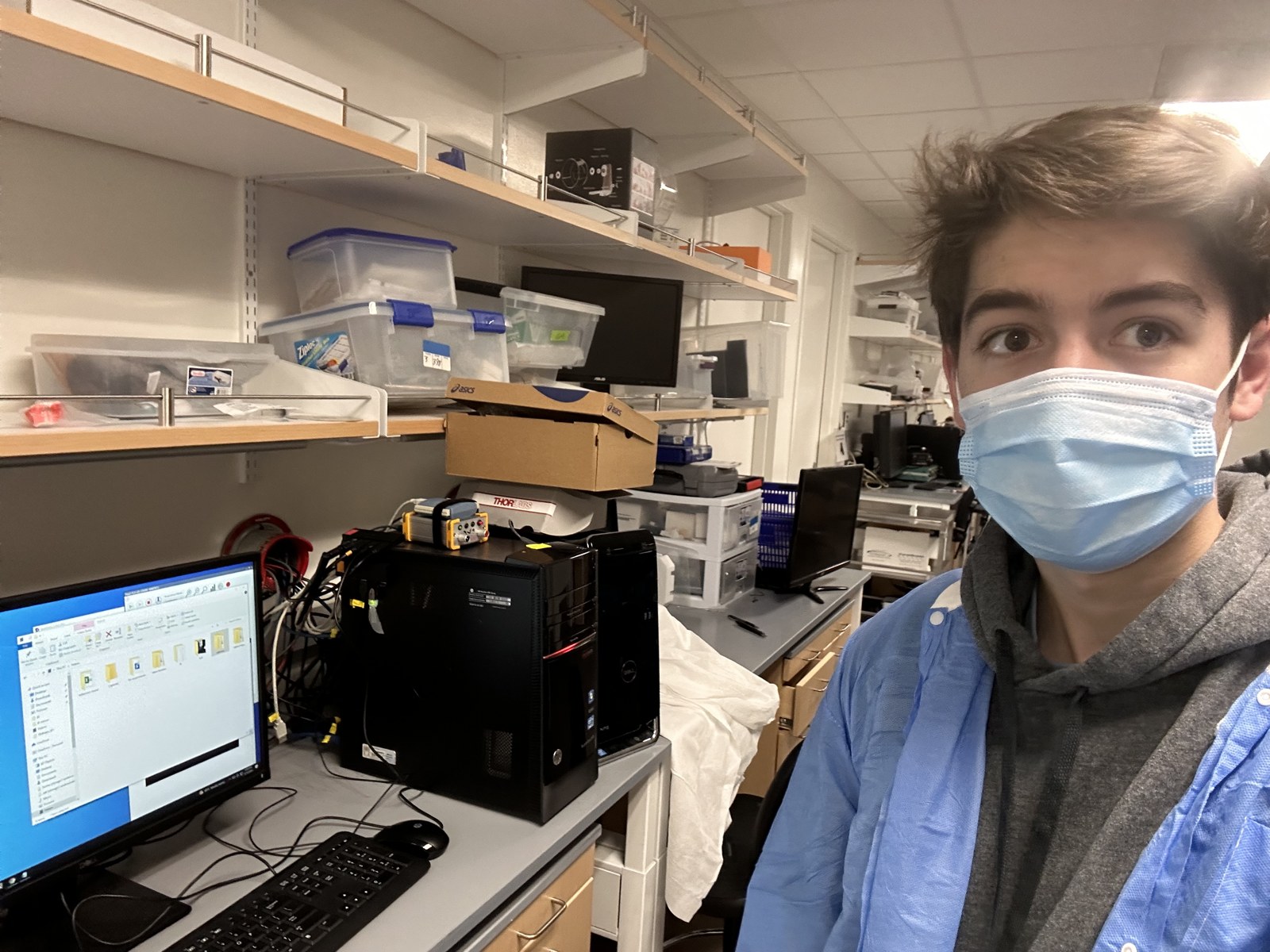
Anderson Lab
Developed the software for an open source non-invasive, low-cost thermal-camera setup to study the relationship between the optogenetic stimulation of various emotional states and body temperature in mice. Conducted the experimental analysis discovering that mice are in fact “hot-headed” and that aggression is correlated with increased body temperatures. CADed an attachment and programmed a custom miniature camera for a setup that enables us to accurately record the facial expressions in freely-behaving mice for the first time.
Thermography Camera Setup
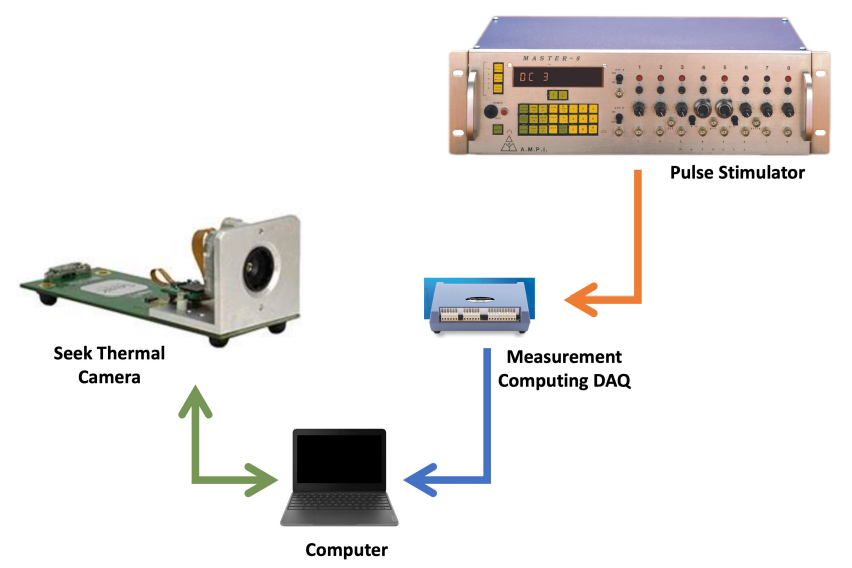
Traditional methods for measuring body temperature in mice, such as rectal thermometers or implanted sensors, can be invasive, expensive, and potentially interfere with natural behavior. To address this, I developed custom C++ software for a low-cost Seek Thermal infrared camera, synchronizing thermal recordings with optogenetic neural stimulation using a data acquisition (DAQ) system. One major challenge was the camera's automatic calibration shutter, which interrupted recordings and caused frames to be lost. I developed a software-controlled calibration solution and implemented both continuous and externally triggered recording modes, enabling reliable, synchronized temperature measurements. I made the software open source on GitHub, allowing other researchers to use and adapt the system for their own experiments.
Behavioral Analysis
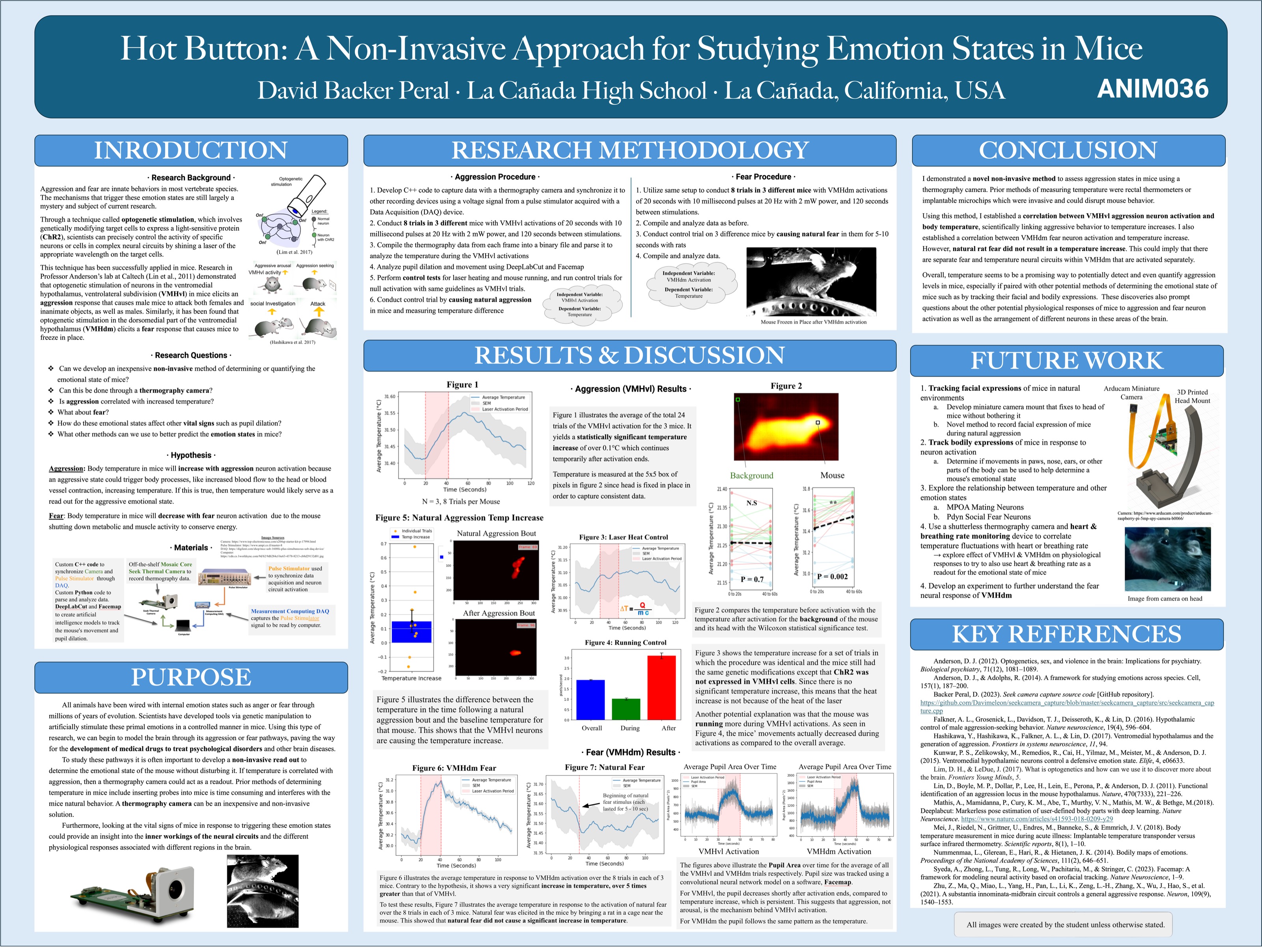
Using this setup, I investigated the relationship between body temperature and emotional states by analyzing recordings from mice undergoing optogenetic stimulation of specific hypothalamic neural populations. I discovered that activating aggression-related VMHvl neurons produced a statistically significant increase in head temperature (p = 0.002) that persisted after stimulation ended. Through additional control experiments and pose-estimation analysis using DeepLabCut, I established that the observed increase could not be explained by laser heating or physical movement alone. I also used Facemap to analyze pupil dilation, finding that pupil size returned toward baseline much faster than temperature, suggesting that these physiological responses reflect different aspects of emotional processing. Interestingly, activating fear-related VMHdm neurons produced an even larger temperature increase, while natural fear elicited by exposure to a rat did not. Our broader experiments also examined natural aggression, social fear, and mating, revealing how distinct neural circuits can produce different physiological signatures.
Miniature Facial Expression Camera Setup
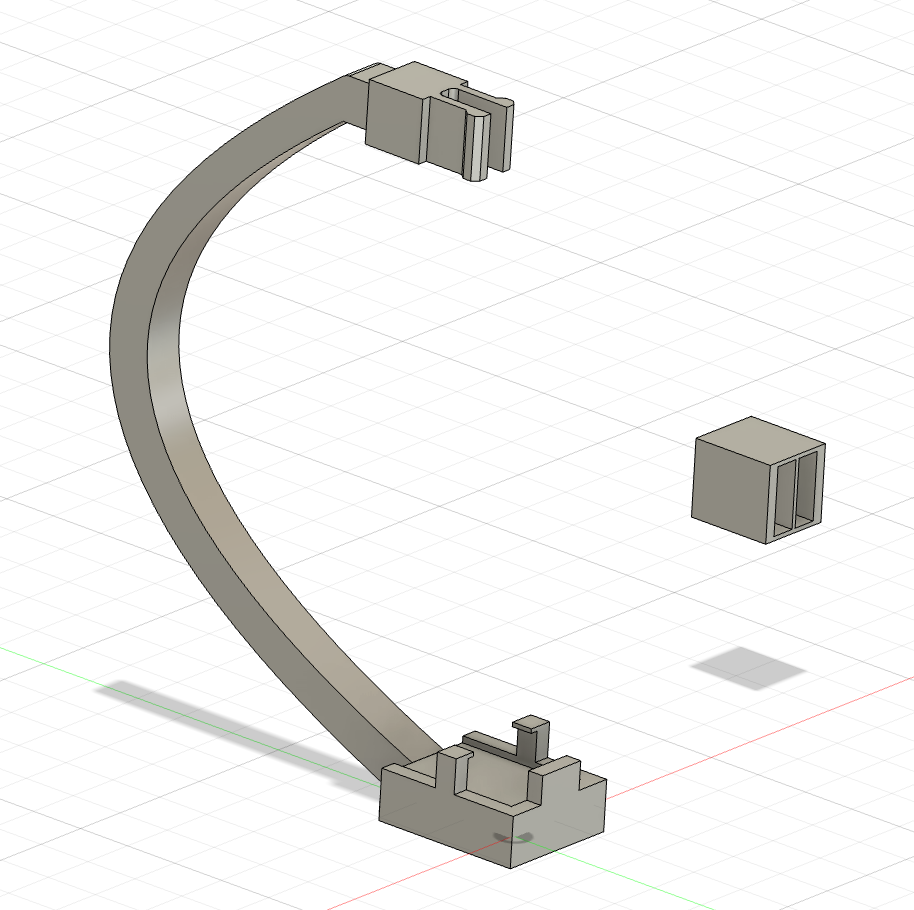
Beyond body temperature, I wanted to explore whether mice exhibit measurable facial expressions associated with different emotional states. To investigate this, I designed a custom 3D-printed head-mounted camera attachment and programmed a miniature camera capable of recording a mouse's face in freely-behaving environments. Unlike conventional facial recording setups that rely on positioning or restraining animals, this miniature system enables researchers to capture facial movements during more natural behaviors. The ultimate goal is to combine facial-expression tracking, thermography, and machine-learning-based behavioral analysis to better understand how emotional states manifest across multiple physiological signals.
Sharing the Work
I had the opportunity to share this research through scientific competitions and presentations. In 2024, the project earned first place at the California Science and Engineering Fair (CSEF), along with the UCLA Brain Institute Award. I was also selected as a finalist at the International Science and Engineering Fair (ISEF) and named a Top 300 Scholar in the Regeneron Science Talent Search (STS). I presented my findings to researchers at Caltech's Anderson Lab and contributed to a research poster for the June 2024 Cold Spring Harbor Laboratory summer course on Brain–Body Interactions.